01 · Task fulfilment
Complete your missions
Follow the instructions, include the required content and keep a clear record of your work. Use feedback to improve your answers.
Ready to explore California's national parks? Follow four trails, build your English skills and become a travel guide for your audience. Each trail helps you prepare your final mission.
Create a 3–4 minute video in English about a national park. Show your audience what makes it special, what visitors can see and do, and how to visit safely and responsibly. Use your own spoken commentary, useful visuals and reliable sources.
Research → practise → analyse a model → create your video.
Learning process: 40% · Park Rules partner audio: 20% · Travel Guide Video: 40%. Your teacher assesses each learner individually.
Follow the instructions, include the required content and keep a clear record of your work. Use feedback to improve your answers.
Stay on task, work independently when asked and contribute to partner work. Use hints and support when you need them, then apply what you have learned.
Your teacher assesses your partner audio: relevant ideas, clear and understandable English, useful language and how you listen and respond to each other. Both partners should contribute.
Your teacher assesses your content and research, structure, language, visuals and task fulfilment. You can find the full video assessment grid in Trail 4.
Finish a trail's required missions to unlock its badge. Collect California Explorer, Ranger Communicator and Yosemite Guide along the way. Your final project leads to California Master Ranger.
Ranger Points show your progress: Trail 1: 25 · Trail 2: 20 · Trail 3: 20 · Trail 4: 35. The exercises give you automated feedback. Your teacher assesses your working process, partner audio and final video. Badges and points do not replace your teacher's assessment.
Look at your route below. Then enter with your class code and Ranger ID. Save a PDF after each trail and export your Ranger Profile to keep a backup.
Work through the trails in order. Save your work after each trail.
Map the parks, research key facts, meet John Muir and complete a writing challenge.
Practise the passive voice, modal verbs and useful safety rules.
Understand a travel guide video, analyse how it works and compare Yosemite with a local park.
Choose a National Park, do your research, plan your video and create your own travel guide.
Find California on the US map, discover its national parks and learn why Yosemite became an important protected place.
Complete a task and your Ranger Coach will suggest your next step. You can follow the recommendation, continue, or try a challenge.
The list is numbered from the start. Use your research to fill it in.
John Muir was one of the most influential people in the early conservation movement in the United States. He loved the natural world and believed that wild places were important for everyone. He did not have political power himself. Instead, he used his writing, his ideas and his personal contacts to change people's minds.
Muir was born in Dunbar, Scotland, in 1838. When he was eleven, his family moved to Wisconsin in the United States. Life on the family farm was hard, but Muir was very curious. He liked machines, inventions and nature. In 1867, he had a serious accident at work and could not see for some time. When his sight returned, he decided to spend more of his life outdoors.
In 1868, Muir reached California and visited Yosemite Valley. He was deeply impressed by the mountains, waterfalls, forests and meadows. He stayed in the area for several years and worked in different jobs. He also spent a lot of time observing plants, animals and glaciers. These experiences helped him understand the landscape better.
But Muir also saw environmental problems. Sheep ate plants in mountain meadows, trees were cut down and more people wanted to use the land for business. Muir began to write articles about Yosemite and the Sierra Nevada. His message was simple: beautiful wild places needed protection, and nature was not only important because people could make money from it.
His writing became more and more important. In the late 1880s, Muir campaigned for stronger protection of Yosemite. In 1890, Congress created Yosemite National Park. Two years later, in 1892, Muir and other conservationists founded the Sierra Club. Muir became its first president. The organisation helped make the conservation movement stronger and more visible.
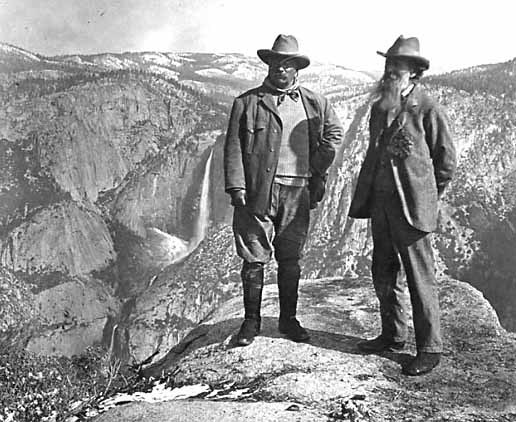
One of Muir's most famous meetings took place in 1903. President Theodore Roosevelt visited Yosemite and spent several days with him. Muir showed Roosevelt the landscape and explained why it should be better protected. Roosevelt already supported conservation, but the trip made the issue even more important at a national level. In 1906, Yosemite Valley and Mariposa Grove came under stronger federal protection.
Muir was not successful in every campaign. A major conflict was about Hetch Hetchy Valley inside Yosemite National Park. San Francisco wanted to build a dam there to get a reliable water supply. Muir and the Sierra Club fought against the plan because they believed that a national park should not be changed in this way. Congress approved the dam in 1913. Muir died one year later, in 1914.
Muir's importance is not only about the battles he won. His books and articles helped many people see wilderness in a new way. He also helped make the idea of national parks more popular. Today, people still discuss the same basic question: How can we meet human needs and at the same time protect the environment?
The dates are already there. Add the important event in one short sentence. Then create your visual timeline and save it in your digital portfolio.
Why was John Muir still important even though he lost the Hetch Hetchy battle? Use information from at least two different parts of the text.
Words often belong to the same family. Complete the missing adjective. One item has two useful adjective forms.
Complete each sentence with a suitable word. Work out the missing words yourself.
Write to a local government or park authority. Explain why a park in your area needs protection and suggest realistic improvements.
Focus on one clear problem, explain why it matters and add 2 or 3 demands that people could support.
Plan how visitors and local people could work together to protect a national park or another protected area.
Choose one task above. You will get ideas, useful phrases and a possible beginning.
Read your partner's text. Do not correct everything. Focus on whether the message is clear and whether the reader knows what should happen next.
Complete the four core missions. Then your Ranger Points are calculated and your California Explorer badge is unlocked.
Download your small Trail Report file and upload it where your teacher tells you, for example in Teams. It contains your results, attempts, support routes and reflections from this trail.
Learn the passive voice step by step, use it for park rules and then practise speaking with a partner.
Your route can change as you work. If you need practice, you will get support. If you are already secure, you can move faster or try a challenge.
Open the video in a new tab. Come back to this page when you are ready.
We use the passive when the action or result is more important than the person who does it.
Rangers protect the trail.
→ The trail is protected.
A storm damaged the path.
→ The path was damaged.
Use by only when the person who does the action is important.
Examples: The trail can be used in summer. Food must be stored safely. Wild animals should be watched from a distance. Plants must not be picked.
Use the situations below. Try to use different modal verbs.
Focus on food, bears, dangerous weather and marked trails.
Prepare: Think of at least three safety rules before you start.
Focus on plants, wildlife, litter and sensitive areas.
Prepare: Think of at least three protection rules before you start.
Follow the conversation from top to bottom. Use the sentence starters if you need them. You can change the wording and add your own ideas.
Try to use at least three of these phrases while your group is discussing the rules.
Complete the grammar route, Ranger Exchange and Ranger Council. Speaking is part of your learning, but it is not scored automatically.
Download your Trail Report and upload it where your teacher tells you. Your report includes your grammar evidence and your partner/group reflections. Speaking itself is not scored automatically.
First understand the video. Then analyse how the travel guide works. Finally, share your ideas and compare Yosemite with a local park.
Open the video in a separate window and place it next to this learning path, like a split screen. Keep the video on one side and your tasks on the other so you can watch, pause and take notes.
How: Click “Open full video” below. If it opens in a new tab, drag that tab out of the browser to create a separate window. Resize and arrange the two windows side by side.
Your Ranger Coach uses your listening, viewing and research results to recommend what to repeat or what to try next.
You can open the full video at any time. The checkpoint buttons below start the video at the right place.
How does the video catch your attention?
How does the guide explain the location?
Which landscape, nature or wow facts make Yosemite special?
Which highlights are presented?
Which activities are mentioned or shown?
What should visitors know before they go?
How does the video finish and leave an impression?
You should now have one useful phrase or chunk for every section. These seven phrases will be saved in your portfolio and can help you plan your own video later.
You will still compare the whole park, but choose one area to look at more closely.
Which idea from one park could be useful for the other park? Explain briefly.
Complete the listening, video analysis, partner exchange and local park comparison. Speaking is recorded as participation only.
Download your Trail Report and upload it where your teacher tells you. It includes listening, viewing, vocabulary and comparison evidence. Partner reflections are included, but speaking itself is not scored automatically.
Create a 3–4 minute National Park Travel Guide video.
Year 8 · 3–4 minutes · 40 assessment points = 40% of your project assessment. Your teacher uses the criteria below. Use them to check your own video before submitting it. In the PDF, tick the description that fits best in each row.
aspects: hook, location, wow facts, must-see places, things to do, useful information, ending
self-assessment: choose the description that fits best in each row and add the points
| criterion | 10 points | 8 points | 5 points | 2 points | 0 points |
|---|---|---|---|---|---|
| 1. content & structure / video quality | |||||
| content & structure | |||||
| video quality | |||||
| 2. language | |||||
| vocabulary & grammar | |||||
| performance | |||||
self-assessment total: – / 40
Before submitting: check length, sound, readable visuals, source credits and your video link or file.
When your video is finished, add the link or file name and do a short self-check.
Ranger Points are awarded only when you finish a trail. Speaking and collaboration are important, but they are not scored automatically.
Complete each trail to unlock its badge. Submit your final project for the Trail 4 badge; your teacher awards the video points separately.
Your work is saved in this browser. Save your Ranger Profile as a backup if you want to continue on another device.
Use your class code and create a personal Ranger ID.